

Join 100K filmmakers:
|
|
Outline
- Trump's Tariff Announcement
- US Production Trends
- Foreign Production Share
- Tariff Status
- Tariff Implementation
- Industry Impact
- Industry + Gov Reaction
- Are Tariffs Wrong Fix?
- Tariff Alternatives
- Conclusion
- FAQs
- How soon could the tariff take effect?
- Would streaming services like Netflix be affected?
- What counts as a “foreign-made” film?
- How would this affect independent foreign films imported to the US?
- Could studios simply release films internationally and skip the US market?
- How would co-productions be treated?
- Would this violate trade agreements?
- Could this lead to retaliatory measures from other countries?
- Are there successful precedents for such cultural tariffs?
- What’s the alternative to tariffs?
TABLE OF CONTENTS
- Trump's Tariff Announcement
- US Production Trends
- Foreign Production Share
- Tariff Status
- Tariff Implementation
- Legal Classification
- Distribution Issues
- Industry Impact
- Industry + Gov Reaction
- Are Tariffs Wrong Fix?
- Tariff Alternatives
- Conclusion
- FAQs
- How soon could the tariff take effect?
- Would streaming services like Netflix be affected?
- What counts as a “foreign-made” film?
- How would this affect independent foreign films imported to the US?
- Could studios simply release films internationally and skip the US market?
- How would co-productions be treated?
- Would this violate trade agreements?
- Could this lead to retaliatory measures from other countries?
- Are there successful precedents for such cultural tariffs?
- What’s the alternative to tariffs?
On May 4, 2025, President Donald Trump announced plans to impose a 100% tariff on all foreign-produced films entering the U.S. market. The move quickly sparked questions and panic the entertainment industry, raising questions about how it would work, if it’s legal, and how it might impact film production worldwide.
In this article, we’ll explain what this tariff proposal means, if it could actually happen, and how it might impact your film projects or career. Let’s dive in!
Key Takeaways:
🌍 Production is leaving the US… way too fast. Everyone knows productions are leaving, but few realize how much: Filming in LA has dropped nearly 40% in ten years, and major studios no longer list any US locations in their top 5 places to shoot. This is a big problem.
⚖️ Tariffs on digital goods would be complicated to implement – Films aren’t goods crossing borders in trucks — they’re intellectual property, often delivered digitally. Applying traditional tariffs to this is complicated and could take years to figure out.
💸 Most film industry people would prefer incentives rather than tariffs – Instead of punishing foreign production, increasing domestic incentives would directly tackles the issue without risking international trade problems.
🕰️ Nothing is happening soon – Trump’s post on social media was not an official executive order. Plus any tariff needs a formal 270-day investigation, industry talks, and likely court challenges. The earliest it could happen is 2026 — if it passes legal hurdles.
What Exactly Did Trump Announce?
On Truth Social, Trump directed the Department of Commerce and the U.S. Trade Representative to begin instituting a 100% tariff on all movies produced outside the U.S. He cited national security, calling the exodus of U.S. film production a threat due to foreign incentives and influence.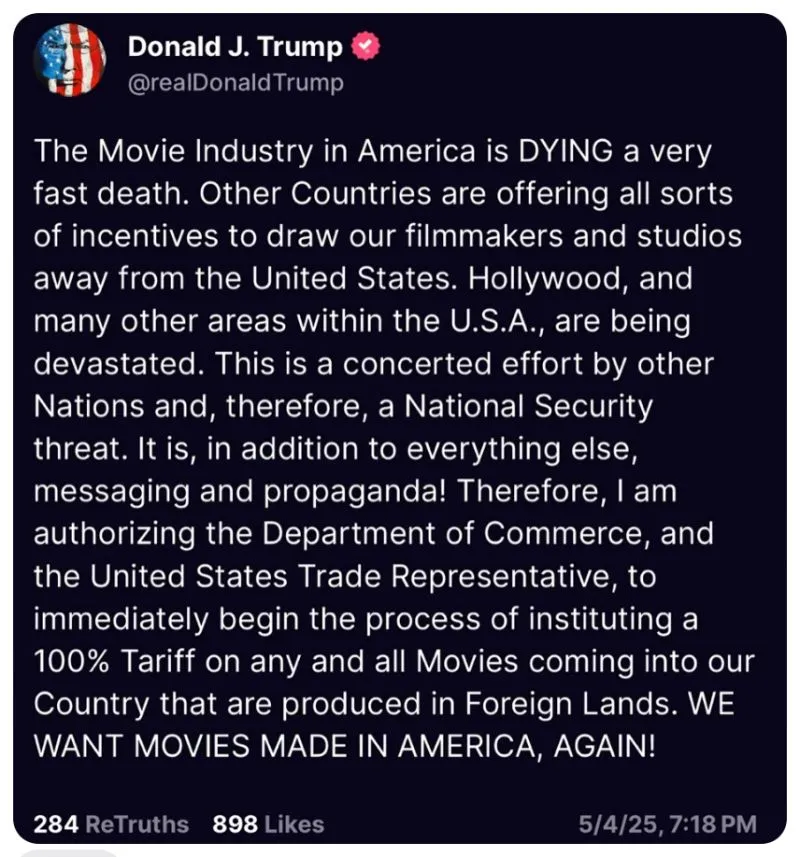
“The Movie Industry in America is DYING a very fast death… This is a concerted effort by other Nations and, therefore, a National Security threat.”
In follow-up comments to C-SPAN, he accused other countries of “stealing the movie industry” and vowed to bring it back.
Notably, this was not backed by a formal policy document or executive order.
| Source | Key Statement | Date |
|---|---|---|
| Truth Social | “100% Tariff on any and all Movies… produced in Foreign Lands” | May 4, 2025 |
| C-SPAN | “Other nations have stolen our movie industry” | May 4, 2025 |
| White House | “Although no final decisions on foreign film tariffs have been made, the Administration is exploring all options” | May 5, 2025 |
Why is this happening now? The state of US production
Trump’s claim that the US film industry is “dying” is supported by some concerning trends:According to FilmLA (the official film office for Los Angeles), film and television production in Los Angeles has fallen nearly 40% over the past decade. Television production in LA peaked in 2021 at about 18,560 shoot days, then plummeted to 7,716 shoot days in 2024 – a 58.4% drop in three years. In the first quarter of 2025 alone, on-location filming in LA fell another 22.4% compared to Q1 2024.
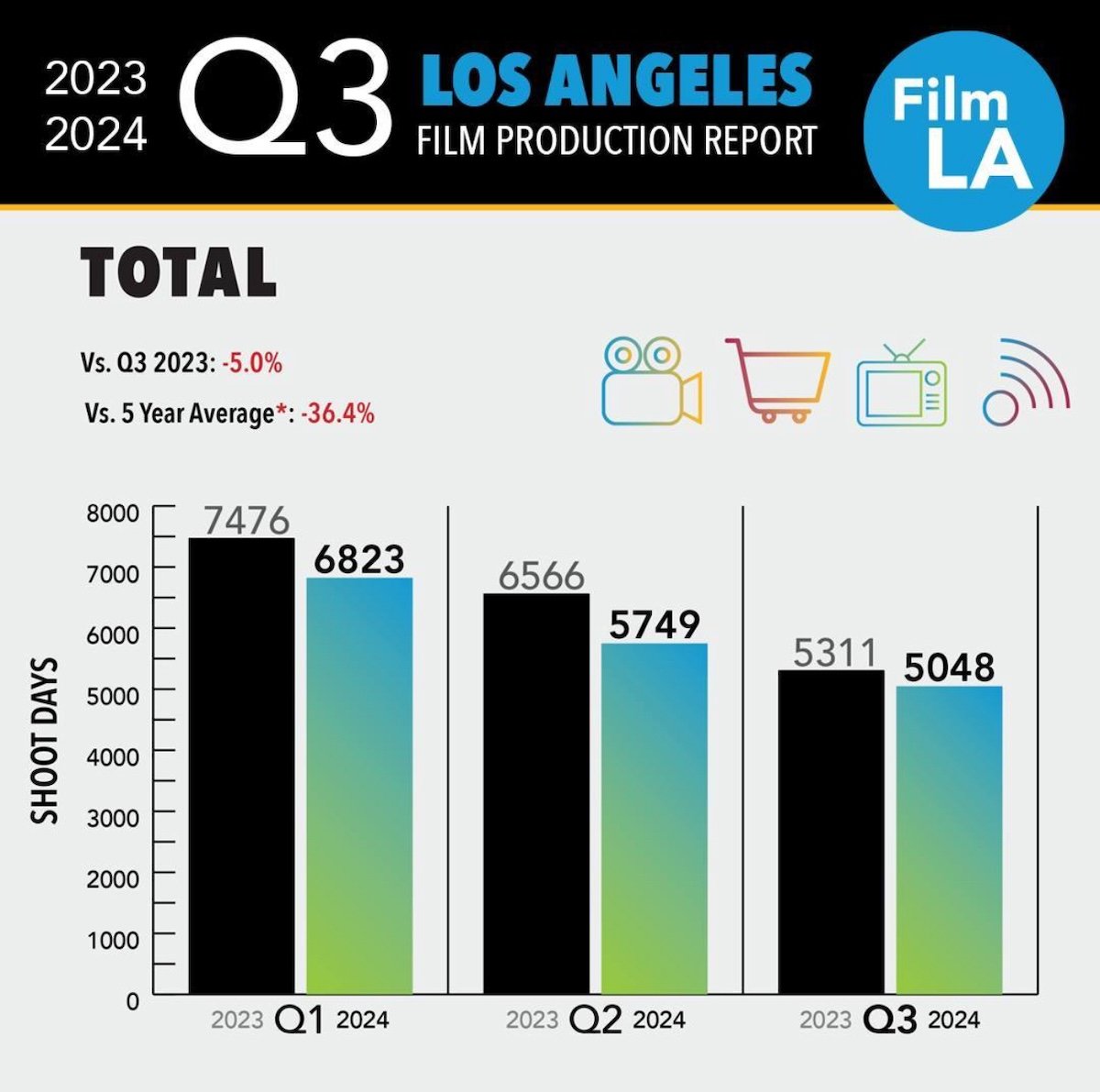 LA’s share of big-budget projects dropped from 23% in 2021 to just 18% in 2023, with productions increasingly favoring international locations.
A ProdPro survey of studio executives found that not a single US location made their Top 5 preferred filming destinations for 2025-2026. Instead, their top choices were:
- Toronto (Canada)
- United Kingdom
- Vancouver (Canada)
- Central Europe (Prague, Budapest)
- Australia
California ranked 6th, followed by Georgia and New Jersey – showing how international locations now dominate studio planning.
How much production happens abroad?
The statistics are stark:In 2024, the United States saw $14.5 billion in major production spending – 26% less than just two years prior (2022). Meanwhile, international production hubs saw growth:
- The UK: $5.9 billion (up 1%)
- Canada: $5.4 billion (up 2.8%)
- Australia/New Zealand: $2.0 billion (up 14%)
The US film industry has lost over 18,000 jobs domestically in the last three years, with a 25% reduction in film/TV employment in Hollywood between 2022-2023 alone.
A big reason for this change is the global “incentive war,” where countries offer big tax breaks and credits. Here is a comparison of some of the incentive options available right now:
| Location | Incentive | Annual Cap | Key Feature |
|---|---|---|---|
| California (US) | 20-25% tax credit | $330 million/year | Does not cover above-the-line costs (star salaries, etc.) |
| Georgia (US) | 30% transferable credit (20% + 10% bonus) | No cap | No-cap program has made Georgia a domestic powerhouse |
| United Kingdom | 25% cash rebate | No cap | No annual limit; covers all qualified UK spending |
| Canada | 35% (provincial) + 16% (federal) combined | Limited provincial caps | Stacking provincial and federal incentives for ~30% effective rate |
| Australia | ~30% combined rebate | Program-specific allocations | 16.5% base + additional incentives up to ~30% |
These incentives, combined with cheaper labor and a strong spending power of the US dollar, has created a powerful economic incentive to film abroad, with productions sometimes saving 30% of their budget through foreign tax incentives.

Are the tariffs actually happening?
Not yet. The day after the announcement, White House spokesperson Kush Desai clarified that no final decisions had been made. The administration is in an exploratory phase, and Commerce Secretary Howard Lutnick only added, “We’re on it.”If pursued, the likely path is through Section 232 of the Trade Expansion Act, which allows tariffs for national security reasons. This would involve:
- A Commerce Department investigation (up to 270 days)
- A national security finding
- A presidential proclamation
Trump has said he plans to consult with industry leaders and could adjust the policy based on feedback.
How would these tariffs actually work?
This is a great question, and even experts are puzzled about how these would be applied. Putting a 100% tariff on “foreign-made films” raises more questions than it answers:Legal Classification Challenges
Films are typically classified as services or intellectual property, not physical goods with regular tariffs. To put tariffs on digital content, the administration would have to find new ways to use current trade laws.Trump’s mention of “national security” suggests using Section 232 authority (used before for steel and aluminum tariffs). But applying this to cultural products would be a new legal theory that would likely face court challenges.
Distribution Channel Complexity
Unlike physical goods, films usually arrive in the U.S. through digital channels or licensing deals, not shipping containers. They’re sent online, not across borders, and often distributed through streaming platforms or exhibition licenses.Because of this, applying tariffs to foreign films isn’t straightforward. The government would need to get creative — maybe by taxing distributors on foreign film licenses, adding fees to box office earnings from international productions, or requiring streaming platforms to report and pay tariffs on non-U.S. content. All of this shows how tricky it is to fit old trade laws to the modern, digital way films are shared today.
Scott Karol, an industry insider who was at the meeting with Jon Voight that kicked off this whole idea, offered a more balanced take than Trump’s blanket plan. He said productions that move everything overseas should be taxed the same amount they got in foreign incentives — but if they film partly in the U.S., they’d get credit for whatever they spend here.
How will this impact studios and indie films?
Many major films today are shot overseas. Recent examples include Mission: Impossible – DR2 (South Africa, Italy), The Fall Guy (Australia), Gladiator 2 (Malta, Morocco), and a long list of UK-based productions like Barbie, Wicked, and most Marvel films.If the tariff goes into effect, studios may face several challenging decisions. They could choose to pay the tariff and absorb the additional costs, which might impact their financial strategies and profit margins. Alternatively, studios might consider shifting production back to the U.S. to avoid the tariff altogether, though this could involve logistical challenges and adjustments to existing production plans. Another possibility is that studios might cancel or delay projects, especially if the financial burden of the tariff makes certain productions economically unfeasible.
Studios like Warner Bros. and Disney, which have major UK operations, would be hit hardest. Analysts estimate a potential 5-10% drop in overall production during the adjustment period.
Foreign hubs like the UK, which took in 6.27B (British Pounds) in 2022, could lose tens of thousands of jobs if U.S. productions pull back.
What are industry leaders and governments saying?
Reactions to Trump’s tariff proposal are mixed:- Hollywood labor unions like SAG-AFTRA and IATSE are hoping it will bring jobs back to the U.S., and are tepidly supportive, but want more details. But the Motion Picture Association, which represents big studios, worries about how it might mess up global distribution.
- Independent producers feel differently; some like the push for more U.S. production, while others are concerned about higher costs.
- California, led by Governor Newsom, suggests expanding state tax credits instead of tariffs.
- The UK government is confused by the proposal and is checking if it breaks trade rules, and Canada is worried about its effect on production centers like Toronto and Vancouver.
Are tariffs the wrong fix?
Most people agree that yes — tariffs alone are not the best solution. Many experts have noted that a flat 100% tariff isn’t precise and could even be a harmful way to boost US production. Here are some reasons why:- Blunt and disruptive: Tariffs are a one-size-fits-all tool that can create chaos without solving the real issues behind runaway production.
- Hard to implement: Films are made in multiple countries and distributed digitally, making tariffs legally and logistically messy.
- Don’t help filmmakers: Unlike tax incentives, tariffs don’t fund productions — they just make it more expensive for them to shoot while collecting money for the government.
Are there better alternatives to tariffs?
Luckily, we have a lot of data over the years from seeing how different state incentive programs have worked. Here are some alternative approaches to boost US production that some in the industry are proposing:- Expanded US Incentives: Instead of punishing productions that film overseas, the U.S. could focus on offering better incentives to bring them back. California, for example, is considering boosting its film tax credit from $330 million to $750 million a year to stay competitive with international options. This kind of approach has strong support in the industry because it builds on a system studios already know and trust.
- Federal Tax Incentive Program: The U.S. could be more competitive globally by creating a national film incentive. Currently, states and other countries are competing with a confusing mix of programs. A federal incentive offering 25-30% back on qualified spending with no yearly cap could make things easier and help the U.S. compete internationally while maintaining strong trade relationships.
- Targeted Tariffs: Scott Karol suggested a more selective approach where tariffs would only apply to productions that completely bypass the US, and only at rates matching foreign incentives (e.g., 30% tariff to offset a 30% foreign credit).
- Infrastructure Investment: Targeted investment in production infrastructure – modern soundstages, post-production facilities, and crew training programs – could address some of the structural advantages that foreign locations have developed.
Will French, a Senior Managing Director of Film and Television Finance at Fallbrook Financial Services, thinks the best way to boost US film production is with transferable tax credits. He points to the state of Georgia, where production companies can sell their credits to investors, helping them raise money and fund more projects. French thinks a nationwide version of this could work alongside state programs to make the U.S. more competitive, especially since some countries already offer up to 60% back in incentives. He calls this approach a “scalpel” — targeted and effective — unlike the heavy-handed “chainsaw” method of tariffs, which he says don’t solve the real problem. (Source: The Wrapbook Podcast interview)
Conclusion
Despite the chaos its announcement has caused, almost everyone agrees that Trump’s plan addresses a real problem: America is losing ground in film production. Slapping a 100% tariff on foreign films is a direct and divisive move, but it’s still unclear whether this will actually happen, or if we’ll see a shift toward offering more incentives instead.Either way, one thing’s clear: the global film landscape is changing quickly, and the decisions made next could reshape where movies get made for years to come.
Frequently Asked Questions
How soon could the tariff take effect?
Would streaming services like Netflix be affected?
What counts as a “foreign-made” film?
How would this affect independent foreign films imported to the US?
Could studios simply release films internationally and skip the US market?
How would co-productions be treated?
Would this violate trade agreements?
Could this lead to retaliatory measures from other countries?
Are there successful precedents for such cultural tariffs?
What’s the alternative to tariffs?

Making a film soon?
We can help you organize your shoot. Check out our Digital Call Sheets and Cast & Crew Management software.
Luke DeBoer
Luke is a filmmaker, developer, and designer. He is also the founder and CEO of SetHero, where he is on a mission to create the film set of the future. Connect with him on LinkedIn.


